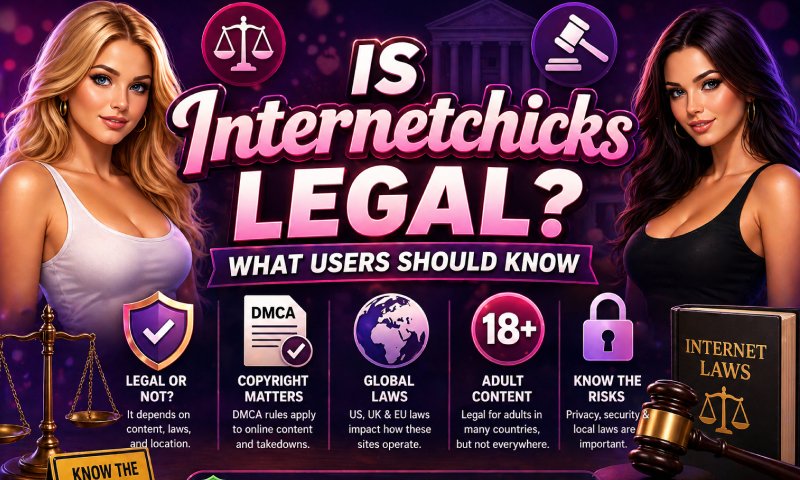
Is Internetchicks Legal? What Users Should Know
Whether Internetchicks is legal is not something that can be answered with a simple yes or no. It depends on a few things, including where the site operates, where the user is located, what kind of content is being hosted or linked, and how the platform handles complaints, takedown requests, and illegal material. In other words, the name of the site alone does not decide legality. The real issue is how the platform works and whether it complies with the rules that apply to online services in the places where it is available.
That is why this question comes up so often. People do not just want to know whether the platform exists. They want to know whether using it creates legal risk, whether the site itself could be operating in a grey area, and whether content on the platform could raise copyright or other legal issues. Those are fair questions, especially with adult-oriented platforms where users often worry about privacy, uploads, reposted material, and changing site behavior. General laws for online platforms do not usually turn on branding alone. They focus on what the service hosts, how it responds to notices, and whether illegal content is left up after the operator becomes aware of it.
The Short Answer
The short answer is this: Internetchicks may be legal in some respects and unlawful in others depending on the content and how the service is run. A platform that hosts user-submitted material is not automatically illegal just because it exists. In the United States, online service providers can qualify for copyright safe-harbor protection under the DMCA if they meet certain conditions, including cooperating with copyright owners and removing infringing material quickly when proper notices are received. U.S. law also gives platforms certain protections for hosting third-party user speech under Section 230, although that does not erase copyright law or make illegal content acceptable.
At the same time, services available in the UK and EU face their own legal duties. Ofcom says online services must protect users from illegal content, and the Online Safety Act compliance guidance requires covered services to assess risk and put protections in place. In the EU, the Digital Services Act sets EU-wide rules for intermediary services, including notice-and-action systems and stronger obligations around illegal content.
Why the Legal Answer Is Not Simple
A lot of people assume a site is either fully legal or fully illegal. In practice, online platforms do not usually work that way.
A site can be legal as a platform while still having specific pages, uploads, or user actions that create legal problems. For example, U.S. copyright law under the DMCA is built around the idea that service providers may receive protection if they follow notice-and-takedown rules, designate an agent, and respond properly to infringement claims. That means legality often depends on compliance and response, not just on the fact that a platform hosts content. In Europe, intermediary liability rules similarly focus on whether the service is acting as a neutral host and whether it removes illegal content once aware of it.
So when someone asks whether Internetchicks is legal, the better question is usually: legal for whom, in which country, and with what kind of content involved? That is the framework that makes the most sense here.
Copyright Is One of the Biggest Legal Issues
One of the biggest legal risks for any site like this is copyright.
If a platform hosts, indexes, or points users toward material uploaded without permission, copyright complaints can become a serious issue. In the U.S., Section 512 of the DMCA creates safe harbors for online service providers, but those protections depend on meeting specific conditions. The Copyright Office explains that providers seeking those protections must designate an agent to receive takedown notices and counter-notices, and they must post that agent information on the site. The broader DMCA framework also requires cooperation with copyright owners and expeditious removal of infringing material when the conditions are met.
That matters for users too. If a site is filled with reposted or infringing material and does not appear to handle complaints properly, that is usually a warning sign. It does not automatically tell you everything about the platform, but it does tell you that copyright compliance is one of the first legal areas to watch. That is also why a strong DMCA Notice page matters so much for sites in this space.
Section 230 Does Not Make Everything Legal
A lot of people misunderstand Section 230 and assume it gives websites blanket protection.
That is not how it works. EFF explains that Section 230 allows web operators to host and moderate user speech and content, but it is not a general pass for every type of legal problem. Most importantly here, Section 230 does not replace copyright law. Copyright claims are handled through separate rules, especially the DMCA. So even if a platform benefits from Section 230 in some situations, that does not protect it from copyright complaints in the same way.
For a platform like Internetchicks, that means legality depends heavily on the details. User-generated content may bring one set of protections. Infringing uploads may bring another set of liabilities. Illegal content can trigger a completely different legal problem again.
UK and EU Rules Matter Too
If a site is available to users in the UK or EU, then U.S. law is not the whole picture.
Ofcom says online services must protect users from illegal content, and its guidance under the Online Safety Act requires covered services to check whether the law applies, carry out illegal-content risk assessments, and implement safety measures where required. That means services available to UK users may face duties that go beyond simply waiting for complaints.
In the EU, the Digital Services Act created EU-wide rules for intermediary services and strengthened the systems around illegal content removal and user protection. The European Commission also explains that the DSA updates the framework for digital services acting as intermediaries for content, while the older e-Commerce rules and the DSA both reject a general monitoring obligation but still require action once illegal content is known.
That is important because it shows the legal question is not just about one country’s rules. A platform can face different obligations depending on where it operates and where its users are located.
What Makes a Site Legally Risky
From a user perspective, a platform tends to look legally riskier when a few signs appear at the same time.
One sign is the absence of clear complaint or takedown procedures. Another is content that appears to be reposted without permission. Another is poor transparency around terms, rules, and contact information. These are not absolute proof that a site is unlawful, but they are red flags because the official legal frameworks for platforms place so much weight on notice handling, removal procedures, and content governance.
That is why legal questions around Internetchicks often overlap with trust questions. If the platform looks unstable, unclear, or difficult to contact, users naturally start asking whether it is not only unreliable but also legally questionable. That is also where pages like Is Internetchicks Safe and What Happened to Internetchicks fit naturally into the cluster.
Is It Illegal for Users to Visit the Site?
This part depends heavily on local law and on what exactly the user is doing.
Simply visiting a website is not the same legal issue as uploading infringing material, redistributing content, running the service, or trying to bypass local restrictions. That is why user-side legality cannot be answered globally in one sentence. Different jurisdictions have different rules, and the legal risk increases if the user is actively uploading, sharing, copying, or otherwise participating in conduct that goes beyond ordinary browsing. Since local law matters so much here, this article should be treated as general information rather than personal legal advice.
The Practical Takeaway
So, is Internetchicks legal?
The most accurate answer is that the platform’s legality depends on compliance, content, and jurisdiction. A site like this is not automatically illegal just because it exists, but it can create legal exposure if it hosts infringing content, fails to respond to valid complaints, ignores illegal content duties, or operates without the safeguards required by the laws that apply to it. U.S. law, UK rules, and EU rules all point in that same general direction: online intermediaries are judged by what they host and how they respond when problems are identified.
For users, the smart approach is simple. Be cautious with any platform that lacks clear rules, transparent contact details, or obvious complaint procedures. If you are worried about risk, it makes sense to also read Is Internetchicks Safe, Internetchicks Not Working, and Internetchicks Alternatives before spending time on the platform.
Final Thoughts
The legal status of Internetchicks is not something that can be settled by the name alone. The real legal questions are about copyright, illegal content, platform duties, and regional law. In the U.S., the DMCA and Section 230 shape part of that picture. In the UK, the Online Safety Act adds duties around illegal content. In the EU, the Digital Services Act does the same for intermediary services. That is why the safest and most honest answer is also the most useful one: Internetchicks may be legal in some contexts and problematic in others, and the details matter a lot.